

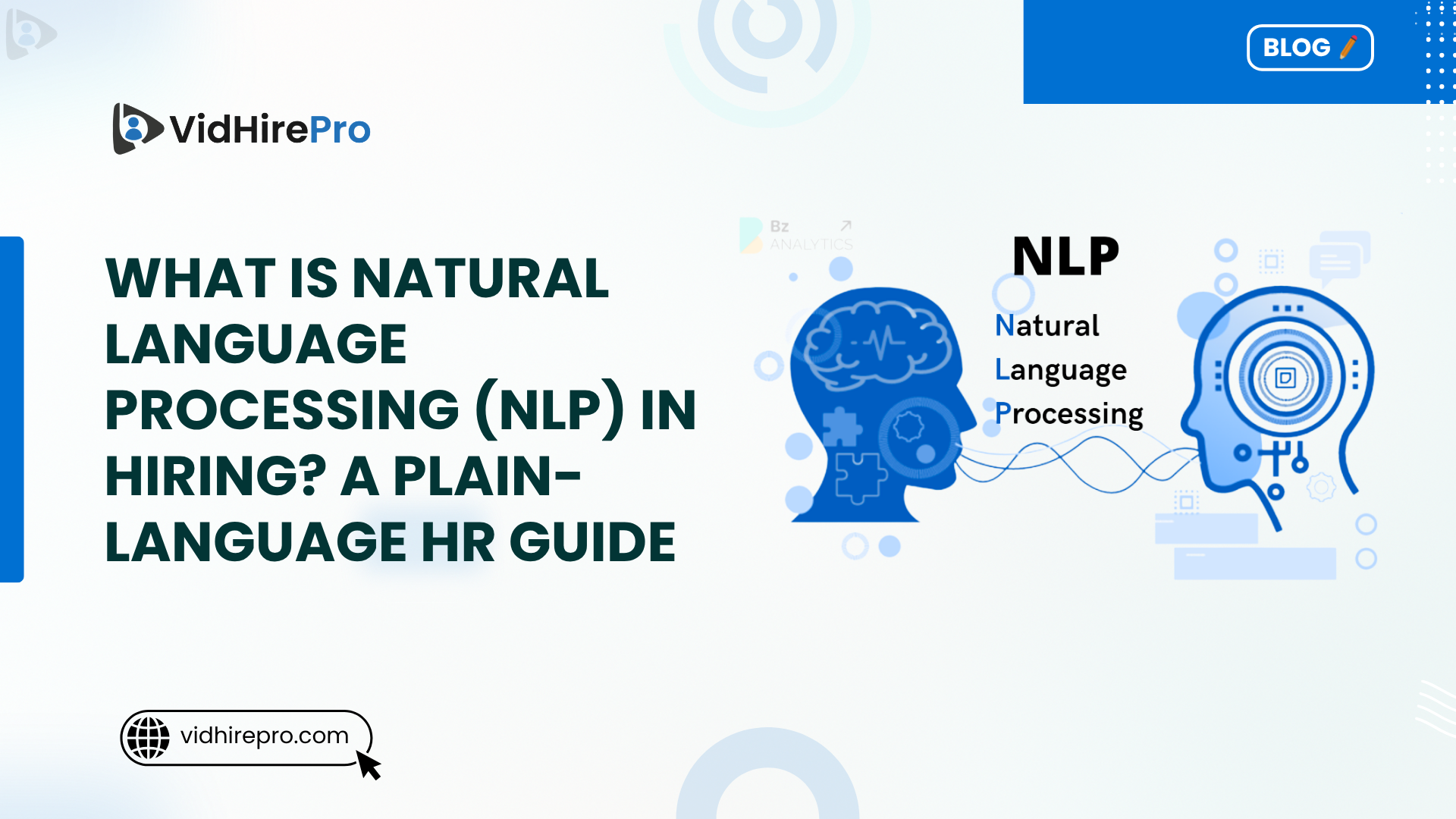
Every time a candidate answers an interview question, they’re communicating far more than the words on the screen can capture. Word choice, sentence structure, verbal confidence, and emotional tone are signals that have always shaped how experienced interviewers evaluate candidates. Natural Language Processing (NLP) gives AI the ability to analyze those signals systematically, at a scale no human team can match, and without the inconsistency that affects every human evaluator.
This guide explains what NLP is, how it works in recruitment, what it can detect in a video interview, and what HR teams need to understand about its capabilities, limitations, and the ethical responsibilities that come with using it.
Natural Language Processing (NLP) Definition for HR Professionals
Natural Language Processing (NLP) is a branch of artificial intelligence that enables computer systems to understand, interpret, and generate human language in contextually meaningful ways. In the context of recruitment, NLP allows AI systems to read and analyze candidate-written or candidate-spoken content resumes, cover letters, interview responses, and application answers with a level of comprehension that goes far beyond keyword matching.
NLP doesn’t just find words. It understands what those words mean in context, how they relate to each other, and what they imply about the candidate’s competencies, communication style, and suitability for a role. According to SHRM’s 2025 Talent Trends report, 51% of organizations now use AI specifically for recruiting, and NLP is the foundational technology powering the majority of those applications.
What NLP Actually Does in Plain Language?
The simplest way to understand NLP is to contrast it with keyword search. A keyword search finds the word “leadership” in a resume. NLP understands that “built and scaled a team from 3 to 25 over 18 months while managing P&L responsibility” means leadership, even if the word itself doesn’t appear. NLP reads for meaning, not just pattern. It understands synonyms, context, implication, and nuance in a way that makes its analysis genuinely useful for evaluating candidate language rather than just cataloging it.
How NLP Differs from Simple Keyword Matching?
Keyword matching is binary: a term either appears or it doesn’t. NLP operates on a spectrum of semantic similarity, understanding that candidates can express the same competency in entirely different languages, and that identical words can mean very different things in different contexts. A candidate who says “I led the team” at a startup has a different leadership experience than one who says the same thing at a multinational corporation. NLP can evaluate the context around those claims in ways that keyword matching cannot.
NLP vs. Machine Learning vs. AI: How They Relate in Recruitment
These terms are often used interchangeably but describe different layers of the same technology stack. Artificial intelligence is the broad category of computer systems designed to perform tasks that would normally require human intelligence. Machine learning is a subset of AI systems that learn from data and improve over time rather than following explicitly programmed rules. NLP is a specific application of machine learning focused on language. In recruitment, NLP is the engine inside the AI tools that evaluates candidate language; machine learning is how that engine improves as it processes more data.
How Does NLP Work in the Recruitment Process?
Resume parsing with NLP goes beyond extracting fields it understands what those fields mean. An NLP-powered parser reads a candidate’s work history and infers competencies from description rather than relying solely on job titles. It matches those inferred competencies against the role’s requirements semantically rather than through exact-match keyword filters.
The result is a candidate ranking based on actual qualification overlap rather than surface-level terminology alignment, which means qualified candidates with non-traditional backgrounds or varied job title histories get a fair evaluation rather than a false rejection.
Interview Response Analysis: From Transcription to Meaning
When candidates complete a pre-recorded video interview through VidHirePro, NLP begins working the moment a response is submitted. The audio is first transcribed through speech recognition, then the transcript is analyzed by NLP models that evaluate response quality, competency alignment, logical structure, and language sophistication. This analysis happens in minutes and produces structured evaluation data, scoring each response against the role’s defined competency rubrics that recruiters receive as part of the candidate’s ranked profile.
Chatbots, Candidate Communication, and NLP-Powered Engagement
NLP also powers the conversational layer of the hiring process. AI-driven chatbots equipped with NLP can answer candidate questions about the role and process, collect initial qualification data, send automated status updates, and schedule interviews, all in natural language that feels responsive rather than scripted. For high-volume hiring programs, this capability dramatically improves candidate experience by ensuring every applicant receives timely, relevant communication regardless of recruiter capacity.
What Can NLP Detect in a Video Interview?
NLP analysis of spoken interview responses evaluates the sophistication and clarity of a candidate’s verbal communication. The vocabulary range, the breadth and precision of the language a candidate uses, is a reliable indicator of communication capability and often correlates with how candidates will perform in high-stakes verbal situations at work. Response structure, whether candidates organize their answers coherently, support claims with specific evidence, and reach clear conclusions, is another NLP-measurable signal that predicts communication effectiveness on the job.
Sentiment Analysis: Tone, Confidence, and Emotional Signals
Sentiment analysis is the NLP capability that evaluates the emotional tone of language. In a hiring context, it identifies patterns associated with confidence, enthusiasm, anxiety, and authenticity in candidate responses. A candidate who uses hedging language consistently (“I think maybe I could,” “I’m not sure but…”) sends different signals than one who communicates with directness and conviction. Sentiment analysis doesn’t make a judgment call on its own; it surfaces patterns that human reviewers can evaluate in context.
Empathy Indicators and Soft Skill Markers in Spoken Responses
This is VidHirePro’s most differentiated NLP application and the one that addresses the biggest gap in AI candidate evaluation. Empathy detection analyzes both the content and the emotional register of candidate language to identify patterns associated with interpersonal awareness, compassion, and genuine engagement. In practical terms, this means identifying candidates who respond to people-centered scenarios with language that reflects real consideration for others’ perspectives, not just technically correct answers. For healthcare organizations, where empathy is a core professional competency, this capability is not a nice-to-have; it’s central to the quality of hire.
What Are the Benefits of NLP in Hiring?
The volume problem in recruiting isn’t a shortage of candidates; it’s a shortage of evaluation capacity. NLP-powered analysis processes every submitted response at the same speed, applying the same analytical depth to the 500th candidate as to the first. This means organizations can give every applicant a meaningful first-round evaluation rather than making early-stage decisions about who deserves attention based on resume formatting or time-slot availability. VidHirePro’s AI screening capabilities bring this processing power to the top of the hiring funnel.
Reducing Reviewer Subjectivity with Consistent Linguistic Analysis
Human evaluators vary. The same recruiter will evaluate a candidate differently on a Monday morning than on a Friday afternoon. Different reviewers apply different implicit criteria to the same language. NLP doesn’t have a good day or a bad day; it applies the same analytical model to every response, producing scores that are comparable across candidates and consistent across the hiring period. This consistency is particularly valuable in high-volume hiring where multiple recruiters are evaluating simultaneously.
Identifying Qualified Candidates Who Might Be Overlooked by Keyword Filters
One of the most tangible benefits of NLP over keyword screening is the recovery of qualified candidates who would otherwise be missed. Non-native English speakers with strong underlying capabilities may express competencies in language that don’t match the expected keyword patterns. Career-changers and candidates with non-traditional backgrounds describe relevant experience using industry-adjacent rather than industry-standard terminology. NLP evaluates the semantic meaning that candidates are communicating rather than surface vocabulary, giving these candidates a fair evaluation that keyword filtering would deny them.
What Are the Risks and Ethical Considerations of NLP in Recruitment?
NLP models trained predominantly on data from native English speakers may systematically undervalue candidates whose language is equally sophisticated but stylistically different. Sentence structures, idiom use, and vocabulary choices that pattern-match to the training data receive higher scores; equally intelligent language that doesn’t match those patterns may score lower. Responsible platforms conduct regular bias audits on their NLP models across linguistic backgrounds and provide documentation of their bias testing methodology. This is a critical evaluation criterion when selecting an NLP-powered screening tool.
Transparency: Can NLP Models Explain Their Decisions?
Explainability is an emerging standard in AI-powered hiring. Recruiters and candidates both deserve to understand why a candidate received the score they received, not just the score itself. NLP models that produce only black-box outputs create compliance risk and erode trust in the evaluation process. VidHirePro’s scoring is designed for explainability: recruiters can see which competency dimensions drove a candidate’s evaluation and review the specific response elements the AI identified as strong or weak.
Regulatory Scrutiny and Bias Audit Requirements
NLP in hiring is subject to growing regulatory oversight. New York City’s Local Law 144 requires bias audits for AI tools used in employment decisions. Illinois’ Artificial Intelligence Video Interview Act requires disclosure and consent when AI analyzes video interview responses. Organizations using NLP-powered screening tools must document their bias audit processes, maintain records of AI use in hiring decisions, and ensure candidates are informed when NLP analysis is applied. VidHirePro’s GDPR and compliance documentation supports these regulatory requirements with audit trails and configurable disclosure workflows.
How VidHirePro Uses NLP to Assess Candidates Beyond the Resume?
VidHirePro’s NLP capabilities are built for the specific demands of video interview assessment, going beyond the document-level analysis that most AI screening tools offer to evaluate the spoken language that reveals how candidates actually think and communicate.
Spoken Language Analysis in One-Way and Live Video Interviews
VidHirePro’s NLP engine analyzes both the content and structure of spoken responses in pre-recorded video interviews and live interview sessions. Every response is transcribed, semantically analyzed against the role’s competency rubrics, and scored for communication quality, response relevance, and language sophistication. The result is evaluation data that reflects how candidates actually communicate under interview conditions, not just how they present on a polished resume.
Empathy and Emotional Intelligence Scoring Powered by NLP
VidHirePro’s empathy detection layer applies NLP analysis to identify language patterns associated with interpersonal awareness, compassion expression, and genuine emotional engagement in candidate responses. For every role where these qualities matter, from nursing to sales leadership to customer success, the platform surfaces candidates who communicate with authentic empathy rather than technically correct but emotionally flat responses. This is a capability gap that no resume-parsing tool can fill, and one that has driven documented results for VidHirePro customers across healthcare and beyond.
Explainable NLP Insights That Help Recruiters Decide with Confidence
Every NLP-generated score in VidHirePro is accompanied by the explanation that makes it actionable: which competency dimensions drove the evaluation, which specific response moments the AI identified as significant, and how the candidate compares to others in the same applicant pool. Recruiters don’t just receive a number; they receive the reasoning behind it. This explainability builds confidence in the AI’s assessments and produces the documentation that compliance teams require.
See VidHirePro’s NLP-powered screening in action. Request a demo and watch the technology evaluate candidates in real time.
FAQs: Natural Language Processing in Hiring
Does NLP Replace Human Judgment in Candidate Assessment?
No. NLP is an analytical tool that surfaces structured evaluation data to support human judgment it doesn’t replace it. The goal of NLP in hiring is to give recruiters better, more consistent information about every candidate so that human evaluation is applied at the highest-leverage moments in the hiring process: the live interview, the reference call, and the final decision conversation. VidHirePro’s approach keeps humans in control of every evaluation decision while NLP does the analytical heavy lifting.
Can NLP Detect When a Candidate Is Dishonest or Scripted?
Not with certainty. NLP can identify patterns associated with highly rehearsed, overly formulaic responses, the kind of language that sounds prepared rather than authentic, and flag these for human review. It can also detect inconsistency between responses to similar questions. But NLP is not a lie detector, and treating it as one would produce unreliable results. It’s a signal-surfacing tool, not a truth machine.
How Accurate Is NLP in Predicting Job Performance?
Accuracy depends on how well the NLP model’s scoring criteria align with actual job requirements. When competencies are clearly defined, rubrics are built for the specific role, and the NLP model has been validated against role performance data, research shows a strong correlation between NLP-scored interview assessments and structured interview outcomes. Platforms that provide validation documentation and conduct regular model audits are the ones to trust.
The Language of Great Hires
The candidates who will thrive in your organization are communicating that fact in every answer they give in their word choice, their reasoning, their empathy, and their clarity. The challenge has always been surfacing those signals consistently, at scale, without burning out your recruiting team or missing the candidates who express themselves differently.
NLP in hiring closes that gap. And VidHirePro puts it to work at every stage of the video interview process, from first screening to final evaluation, so the language of every candidate becomes actionable hiring intelligence.
See what NLP-powered hiring looks like for your team. Explore VidHirePro’s platform or request a demo and discover the candidates your current process is missing.