

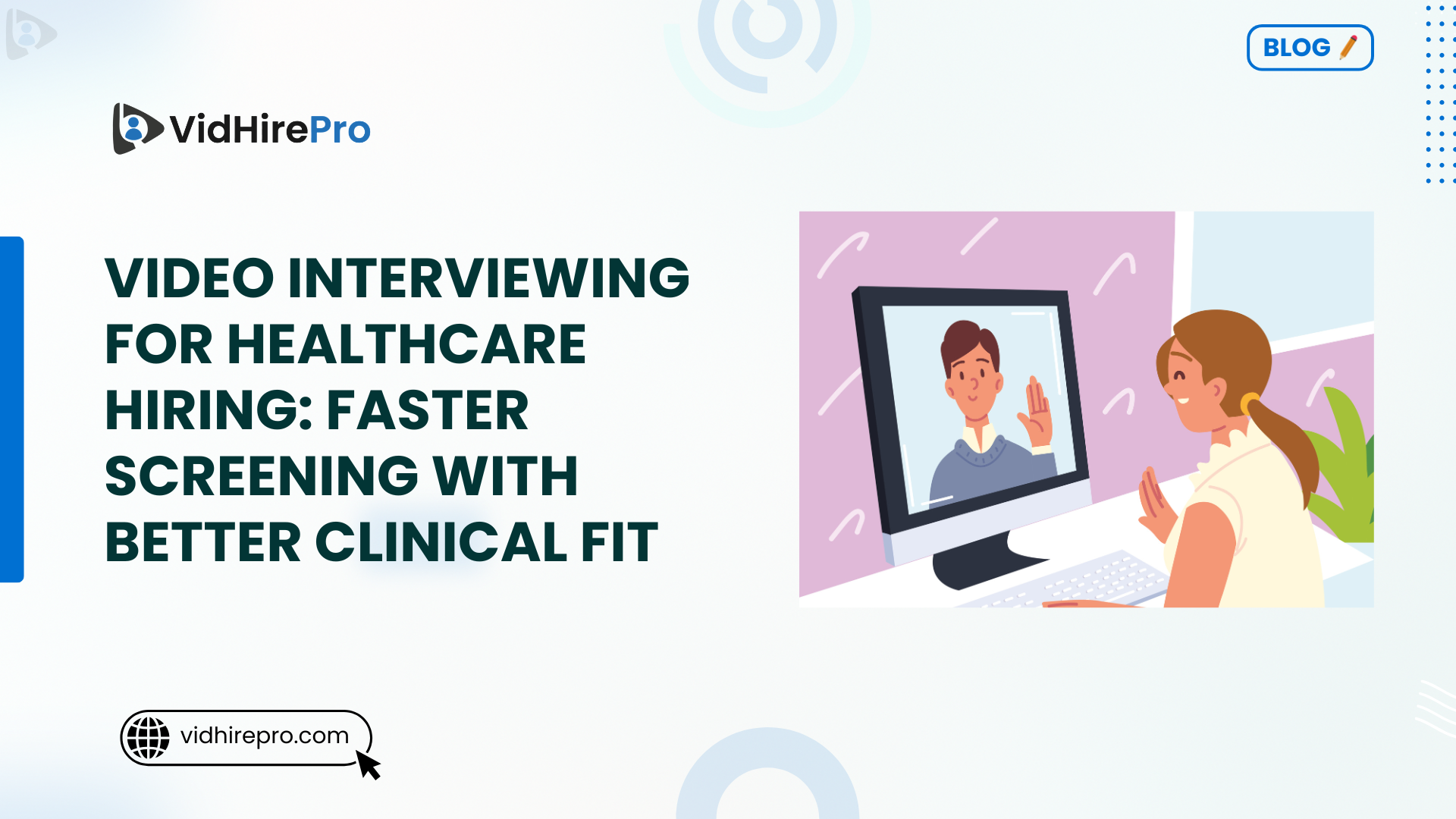
Healthcare hiring teams are stretched thin, and every open shift adds pressure to fill roles fast. Traditional screening drags out for weeks, while candidates who could deliver excellent patient care take other offers. Video interviewing for healthcare hiring changes that equation. It lets recruiters review communication skills, licensure details, and bedside manner before ever scheduling an onsite visit.
This article covers why healthcare teams are moving to video interviews. You will also see what signals a strong clinical fit, and how VidHirePro helps teams screen faster. By the end, you will have a clear picture of how to apply this approach to your own hiring pipeline.
The Growing Challenge of Healthcare Hiring Today
Healthcare organizations are under constant pressure to fill critical roles quickly, but speed cannot come at the cost of quality. This section looks at what is driving the current strain on healthcare hiring teams.
Rising Turnover and Staffing Shortages in Healthcare
Healthcare employers across nursing, allied health, and clinical support roles continue to see high turnover. Staff leave for better schedules, higher pay, or burnout relief, and each departure creates an immediate gap in patient care coverage.
Recruiters are often asked to fill several open requisitions at once, across multiple departments and shifts. This volume makes manual screening nearly impossible to sustain without slowing down every other part of the hiring process.
Why Traditional Screening Methods Slow Down Hiring?
Phone screens and early stage panel interviews require coordinating calendars across recruiters, hiring managers, and candidates who may already be working full shifts. Scheduling alone can add days or weeks before a conversation even happens.
By the time a candidate reaches an interview, a competing offer may already be on the table. Traditional screening was not built for a market where clinical talent has multiple options.
The Real Cost of a Long Time to Hire in Clinical Roles
Every day a clinical role sits open, existing staff absorb the extra workload. That pressure contributes to fatigue, mistakes, and further turnover, creating a cycle that is difficult to break.
Extended vacancies also affect patient experience, since unfamiliar staffing patterns and overtime coverage rarely match the consistency of a fully staffed team. Reducing time to hire is not just an efficiency goal. It is a patient care goal.
Why Video Interviews Work Well for Clinical Hiring?
Once a healthcare organization recognizes the screening bottleneck, the next question is what to do about it. Video interviewing gives recruiters a faster, more consistent way to evaluate candidates early.
Screening Communication and Bedside Manner Early
Clinical roles depend heavily on how a candidate communicates with patients, families, and care teams. Video interviews let recruiters observe tone, clarity, and empathy directly, rather than relying on a resume or a brief phone call.
This is especially valuable for roles like nursing, patient care technicians, and front desk clinical staff, where communication style can be as important as technical skill.
Assessing Cultural Fit Before the OnSite Interview
Every healthcare facility has its own pace, culture, and expectations around teamwork. Video interviews give hiring managers a chance to gauge whether a candidate’s working style aligns with the unit before investing time in an onsite visit.
This early read helps prevent mismatches that often surface only after a candidate has started, when the cost of a bad fit is much higher.
Reducing Scheduling Conflicts for Busy Clinicians
Hiring managers in healthcare are often clinicians themselves, which means their calendars are unpredictable. Video interviews, especially one way formats, let hiring managers review candidates on their own time instead of coordinating a live call.
This flexibility keeps the hiring process moving even during the busiest weeks on the floor.
What Makes a Candidate a Good Clinical Fit?
A strong clinical fit combines verified technical competency, dependable soft skills like empathy and clear communication, and behavioral signals such as calm decision making under pressure. Video interviews make these traits visible early, before a candidate ever reaches a panel interview or onsite visit.
Technical Competency and Certifications
Confirming licensure, certifications, and hands on experience is still the foundation of any clinical hiring decision. Video interviews are a good moment to ask candidates to walk through specific scenarios from their background.
This gives recruiters and hiring managers a clearer sense of real world competency, rather than relying only on what is listed on a resume.
Soft Skills That Matter in Patient Care
Empathy, patience, and active listening are difficult to assess from paperwork alone. On video, recruiters can watch how a candidate responds to a scenario based question about a difficult patient interaction.
These moments often reveal more about day to day fit than years of experience alone.
Behavioral Signals to Look For on Video
Pay attention to how candidates handle unexpected questions, how they describe conflict with coworkers, and whether their energy matches the pace of the unit they are applying to.
Consistency between what a candidate says and how they present themselves on video is often a strong predictor of how they will perform once hired.
How Does Video Interviewing Speed Up Healthcare Screening?
Video interviewing speeds up healthcare screening by removing scheduling delays, letting hiring teams review multiple candidates in parallel, and giving recruiters structured, comparable evaluations. Instead of waiting days for a single phone call, teams can move several candidates through screening in the same time it once took to schedule one.
OneWay Video Interviews for Initial Screening
One way video interviews let candidates record responses to a standard set of questions on their own schedule. Recruiters review the recordings in bulk, comparing answers side by side instead of one call at a time.
This is especially useful for high volume roles where dozens of candidates need to be screened for the same opening.
LiveVideo Interviews for Panel Review
Live video interviews bring hiring managers and clinical leads into the process without requiring anyone to travel. A panel can meet virtually, ask follow up questions, and make a decision together in real time.
This keeps the process collaborative while still saving the time an in person panel would require.
AI Assisted Shortlisting and Scorecards
Structured scorecards and AI assisted review help recruiters spot strong candidates faster, especially when hiring volume is high. Instead of reviewing every recording in full, teams can prioritize the strongest responses first.
This does not replace human judgment. It simply gives recruiters a faster starting point for where to focus their attention.
How VidHirePro Supports Healthcare Recruiting Teams?
This is exactly the gap VidHirePro was built to close for healthcare recruiting teams. The platform brings structure and speed to every stage of video based screening.
Structured Interview Templates for Clinical Roles
VidHirePro gives recruiters ready to use templates built around common clinical roles, so every candidate is asked consistent, role relevant questions. This reduces bias and makes it easier to compare candidates fairly.
Templates can be adjusted for specific units or specialties, keeping the process consistent without being rigid.
Collaboration Tools for Hiring Managers and HR
Hiring managers, HR, and clinical leads can review the same candidate recordings, leave feedback, and rate responses inside one shared workspace. This keeps everyone aligned without endless email threads or extra meetings just to compare notes.
Feedback stays attached to each candidate profile, so anyone joining the conversation later can catch up quickly instead of asking teammates to repeat themselves.
Integration With Applicant Tracking Systems
VidHirePro is designed to fit into the hiring workflow your team already uses, rather than replacing it. Candidate data and interview results can flow into your existing applicant tracking system, keeping records in one place.
This means recruiters do not need to manage two separate systems or manually copy information between platforms. Many teams start by booking a short walkthrough to see these tools applied to their own open roles.
Getting Started With Video Interviewing for Your Healthcare Team
Healthcare hiring does not have to mean a tradeoff between speed and quality. Video interviewing gives recruiters a faster way to evaluate the traits that actually predict success in patient facing roles. Teams that adopt it screen more candidates, spend less time coordinating calendars, and reach hiring decisions with more confidence.
Steps to Roll Out Video Interviews
Getting started does not require overhauling your entire hiring process. A simple rollout usually follows a few clear steps.
- Identify the roles with the highest volume or the longest time to hire.
- Build structured interview templates for those roles.
- Introduce one way video screening before the first live conversation.
- Bring in hiring managers for a short live panel review.
- Track results and adjust templates as you learn what predicts success.
Book a Demo With VidHirePro
The fastest way to see how this works for your team is to walk through it directly. VidHirePro’s team can show you how structured video interviews, collaborative scorecards, and ATS integration fit into your specific hiring process.
Faster screening and better clinical fit are not mutually exclusive. With the right process, your team can have both.
Ready to see it in action? Book a Demo and let VidHirePro show you how much time your team can get back.